High Voltage Oil Immersed Transformer: What Buyers Need to Know Before Specifying One
Specifying a high voltage oil immersed transformer sounds straightforward until you're staring at a quote with a dozen variables. Capacity, voltage class, cooling method, insulation grade, each one changes performance and cost in ways that aren't obvious on paper. This guide breaks down what actually matters when you're sourcing one of these units for an industrial site or utility project, using a 1250kVA 35kV model as a reference point throughout.
Why Oil Immersion Still Dominates High Voltage Applications
Dry-type transformers get a lot of attention for indoor flexibility, but at 35kV and above, oil immersion remains the practical default. Oil does double duty here. It insulates the windings electrically and it pulls heat away from the core, something air alone struggles to do once voltage and load climb past a certain threshold.
Think of the oil less like a lubricant and more like a shared workload partner. The winding generates heat, the oil absorbs it, and the tank's external fins release it to ambient air through natural convection. Remove the oil and you'd need dramatically more copper, more insulation clearance, and a far bigger footprint to achieve the same dielectric safety margin. That's a tradeoff most utility and industrial buyers aren't willing to make.
There's also a cost logic at play. Mineral oil is inexpensive relative to the alternative insulation systems that dry units rely on at high voltage, which keeps the overall unit price more manageable even as capacity scales up into the megawatt range.
Breaking Down the 1250kVA 35kV Configuration
A 1250kVA transformer rated at 35kV sits in a specific niche: large enough for a factory substation or a distribution feeder, not so large that it requires the civil infrastructure of a grid-scale unit. Here's how the core specs translate into real-world suitability.
| Specification | Value | Practical Implication |
|---|---|---|
| Rated Capacity | 1250kVA | Supports mid-size industrial loads or a cluster of commercial feeders |
| Voltage Rating | 35kV | Positions the unit for primary distribution, not final step-down to utilization voltage |
| Cooling Type | Oil-immersed | Relies on natural convection through external radiator fins |
| Insulation Medium | Mineral oil | Provides dielectric strength and thermal transfer in one medium |
This capacity band tends to show up in exactly the places you'd expect: a manufacturing plant's main substation, a water treatment facility, or a distribution point feeding several smaller downstream transformers. If your load calculations land somewhere between 800kVA and 1600kVA, 1250kVA is often the closest standard rating without over-provisioning.
How the Core and Winding Design Affects Running Costs
Nobody budgets for a transformer expecting it to be cheap to own, but the difference between an efficient core design and a mediocre one compounds over fifteen or twenty years of continuous operation. Core losses and winding losses both convert into heat and wasted electricity, every single hour the unit is energized.
A well-designed core minimizes no-load losses, which occur constantly whether the transformer is lightly loaded or running near capacity. Winding design, meanwhile, governs load losses, the portion tied directly to current flow. According to the product specifications, this unit's core and winding configuration is built to maximize efficiency while minimizing these operational losses. For a facility running equipment around the clock, even a modest efficiency gain translates into real savings on the utility bill over the transformer's service life.
It's worth asking any supplier for loss figures in writing rather than taking "efficient" as a marketing claim. Numbers on a test report settle the question far better than adjectives in a brochure.
Reading the Terminal Layout and Monitoring Components
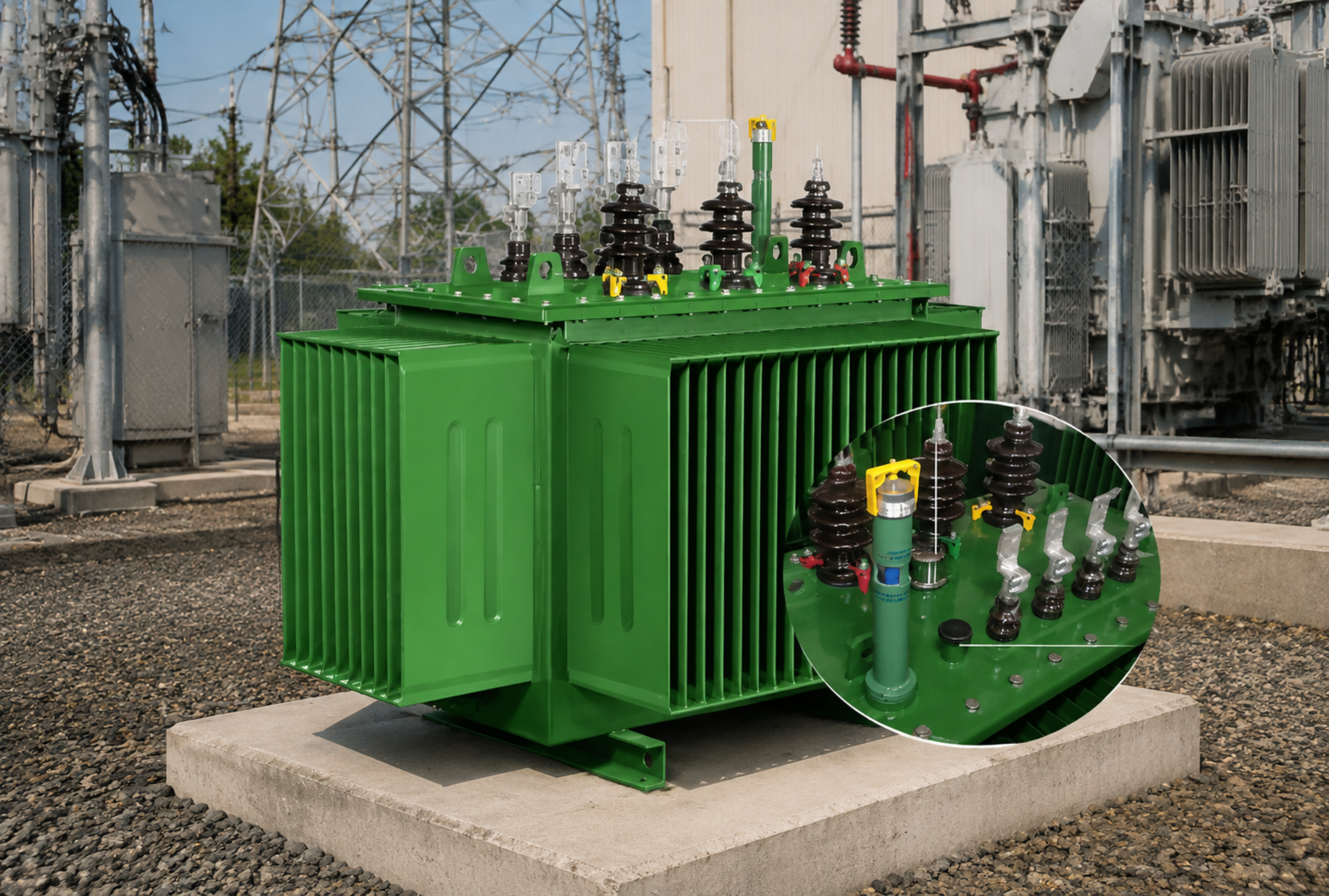
If you've never worked directly with a unit this size, the top-mounted hardware can look like an intimidating cluster of ceramic and metal. It's actually a fairly logical layout once you know what each piece does.
The brown porcelain insulators you see breaking through the lid are the HV and LV terminals, the points where incoming and outgoing conductors connect. Porcelain is used precisely because it holds up under weather exposure while maintaining dielectric separation between the live conductor and the grounded tank body. Next to the terminals sits the tapping switch, which lets technicians adjust the turns ratio slightly to compensate for voltage fluctuations on the supply side.
Two other components matter just as much, even though they're easy to overlook on a spec sheet:
- Oil level indicator: a vertical gauge confirming the tank is adequately filled, since low oil directly compromises both insulation and cooling.
- Temperature monitoring components: mounted on the lid, these give operators a way to catch overheating before it becomes a failure.
Neither of these is glamorous, but both are the kind of detail that separates a transformer you can trust unattended for years from one that needs constant babysitting.
Build Quality: What's Actually Holding This Thing Together
Transformers this size don't fail gracefully. A structural weakness that seems minor during installation can turn into a serious maintenance headache, or worse, a safety incident, five years down the line. That's why the physical construction deserves as much scrutiny as the electrical specs.
The unit's heavy-duty metal frame and base-mounted steel channels are designed to anchor it securely during installation and keep it stable under the mechanical stress of thermal expansion and contraction. Bolt holes at the base are positioned for standard mounting hardware, which simplifies the civil work needed on-site. The green-painted exterior isn't purely cosmetic either; a quality protective coating resists corrosion from weather exposure, which matters considerably more for outdoor-installed units than for anything kept indoors.
Vertical cooling fins run the length of the tank body. These aren't just decorative ridges, they increase surface area so the oil can shed heat into the surrounding air more effectively, a detail that becomes increasingly important as load factor climbs during peak demand periods.
Matching the Transformer to Your Application
Choosing the right configuration isn't a guessing game if you work through it systematically. Here's a practical sequence for narrowing down whether a 1250kVA 35kV oil immersed unit fits your situation.
- Calculate your actual load demand, including a reasonable growth margin, rather than sizing strictly to current consumption.
- Confirm the incoming supply voltage matches or can be stepped down appropriately to the transformer's rated input.
- Check your site's spatial and environmental constraints, since oil-immersed units need adequate clearance and, ideally, outdoor or well-ventilated placement.
- Review local regulations on oil-filled equipment, particularly around containment and fire safety, before finalizing a purchase.
- Request documented efficiency and loss data from the supplier instead of relying on general claims.
Skipping any of these steps tends to surface problems later, usually at the worst possible time, mid-installation or during a critical load event.
Where This Capacity Range Gets Deployed
The application scenarios for a 1250kVA 35kV unit cluster around three recurring situations. Industrial power distribution networks use it as a step-down point feeding plant machinery and process equipment. Utility-scale transmission projects deploy it at substations where 35kV lines need to branch into manageable distribution segments. Large infrastructure projects, think airports, hospitals, or multi-building commercial developments, use it as a mid-tier link between the grid and site-level electrical rooms.
What ties these together is a shared need for dependable, continuous operation in a form factor that doesn't require the kind of civil engineering a grid substation transformer would demand.
Frequently Asked Questions
How long does a high voltage oil immersed transformer typically last?
Service life varies with load factor, maintenance quality, and ambient conditions, but well-maintained units in this voltage and capacity class commonly operate for decades. Routine oil testing and keeping cooling fins unobstructed go a long way toward reaching that upper range.
Is a 1250kVA rating oversized for a mid-size manufacturing facility?
Not necessarily. It depends on your connected load and growth plans. Many facilities deliberately size slightly above current demand to avoid a costly replacement cycle five years later when a new production line comes online.
Does the oil need periodic replacement?
Oil doesn't typically need full replacement under normal conditions, but periodic sampling and testing for dielectric strength and contamination is standard practice to catch degradation early.
Can this transformer be installed indoors?
Oil-immersed units are generally installed outdoors or in dedicated, well-ventilated substations due to fire safety and oil containment considerations, which differs from many dry-type alternatives suited to indoor placement.
Final Considerations Before You Buy
Specifying a high voltage oil immersed transformer ultimately comes down to matching load requirements, site conditions, and long-term operating costs against what a supplier can actually document, not just advertise. A 1250kVA 35kV unit occupies a practical middle ground for industrial and utility distribution needs, provided the core efficiency, structural build, and monitoring components hold up to scrutiny.
For us at FORUI, this kind of transformer reflects nearly two decades of manufacturing experience applied to a straightforward goal: giving buyers a high voltage oil immersed transformer that performs reliably without demanding constant intervention. Whether you're planning a new substation or replacing aging equipment, working through the specifications methodically, rather than taking any single claim at face value, remains the surest path to a transformer that fits your load, your site, and your budget for years to come.
Recent Posts
- FORUI Makes a Strong Appearance at ENERGETAB Poland 2025, Deepening European Market Presence
- FORUI Presents at Uzbekistan Energy Week 2025, Contributing to Central Asia's Energy Development
- FORUI Shines at Electrical Networks of Russia 2024, Showcasing Strength of Intelligent Manufacturing
- Power Transformer Basics: How Oil-Immersed Units Keep the Grid Running
- Compact Substation: Engineering Precision in Modular Power Distribution
SUBSCRIBE
INQUIRY