Power Transformer Basics: How Oil-Immersed Units Keep the Grid Running
A power transformer sits at the point where high voltage meets the wires people actually rely on. It steps voltage down so factories, substations, and neighborhoods can draw electricity safely. When one fails, the outage rarely stays quiet for long, which is why engineers spend so much time thinking about the design choices hiding inside the tank.
Most of those choices come down to two questions: how much energy does the unit waste as heat, and how well does it survive years of temperature swings and mechanical stress. Oil-immersed transformers answer both questions differently than dry-type units, and understanding that difference matters before anyone signs off on a purchase order.
Why No-Load Loss Quietly Drains Budgets
No-load loss is the energy a transformer burns just by being energized, whether or not it's serving any actual load. It comes from magnetic hysteresis and eddy currents in the core steel, and it never stops, even at 2am when the factory floor is empty.
Over a fifteen or twenty year service life, that constant drip adds up to a real number on the electricity bill. Utilities and industrial buyers who run dozens or hundreds of units feel this most acutely, since even a small percentage improvement multiplies across the fleet.
This is where core material and lamination technology start to matter more than most people expect. Older S9-series designs, still common in many installations, use core steel and winding configurations that predate the efficiency gains built into newer product lines.
What the S11 Design Changes
The S11 series 3-phase oil-immersed power transformer, rated for 6/10kV distribution, was engineered specifically to close that efficiency gap. According to the manufacturer's specifications, it delivers over 30% lower no-load loss than comparable S9 models, alongside a 45% to 80% reduction in no-load current.
That current reduction is worth pausing on. Lower no-load current means less magnetizing energy is wasted just to keep the core field established, which also tends to ease harmonic distortion on the supply side. For sites with sensitive electronic loads nearby, that's not a trivial side benefit.
The efficiency gain traces back to core construction and lamination quality, refinements in the steel grade and stacking method that reduce hysteresis losses without changing the transformer's basic operating principle. It's evolutionary engineering, not a reinvention of how transformers work, and that's exactly why it's dependable.
The Corrugated Tank: Less Hardware, Same Job
Traditional oil-immersed transformers often rely on a separate oil conservator tank mounted above the main body, connected by piping, to accommodate oil expansion as temperature rises. It works, but it adds bulk, adds joints that can leak, and adds another component to inspect during maintenance.
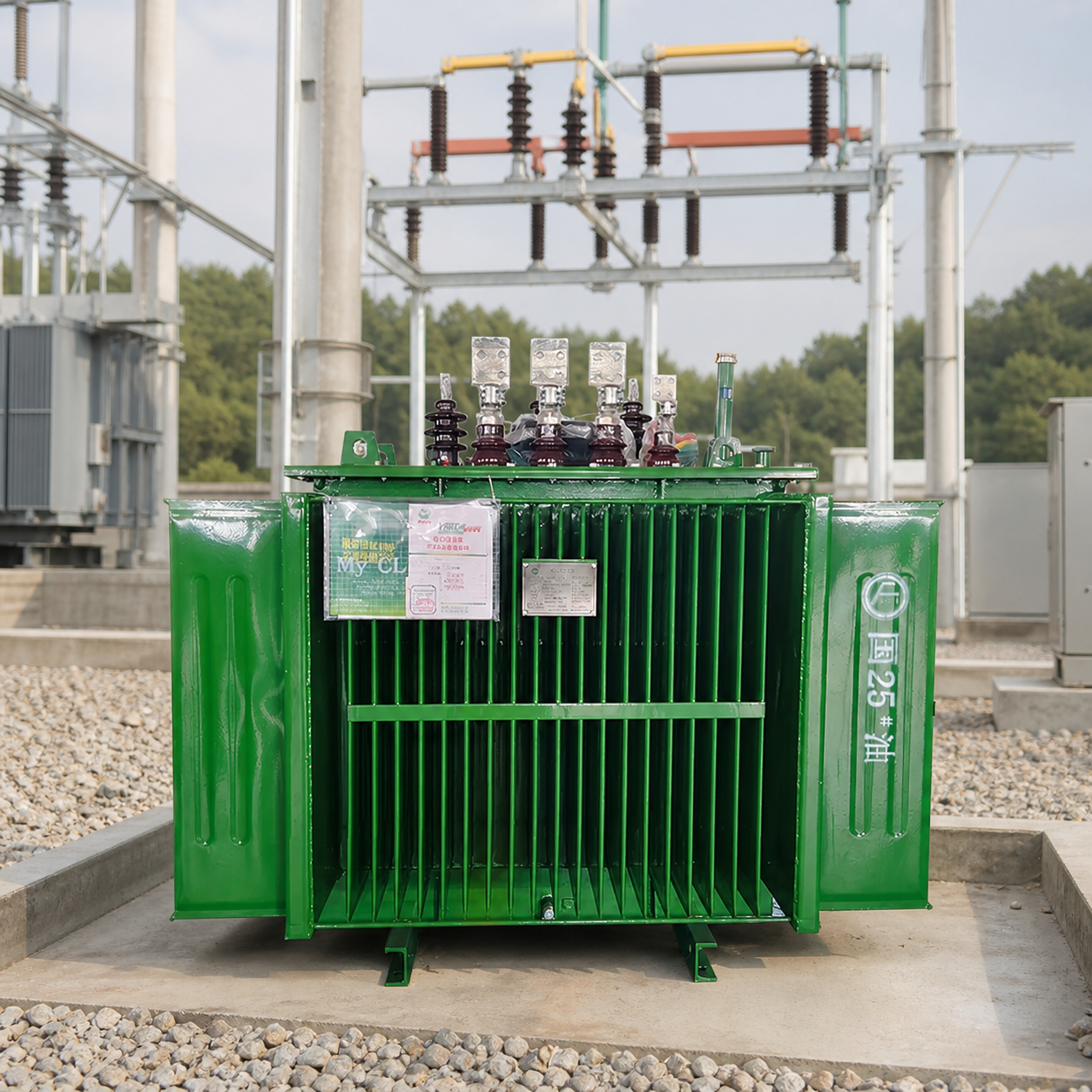
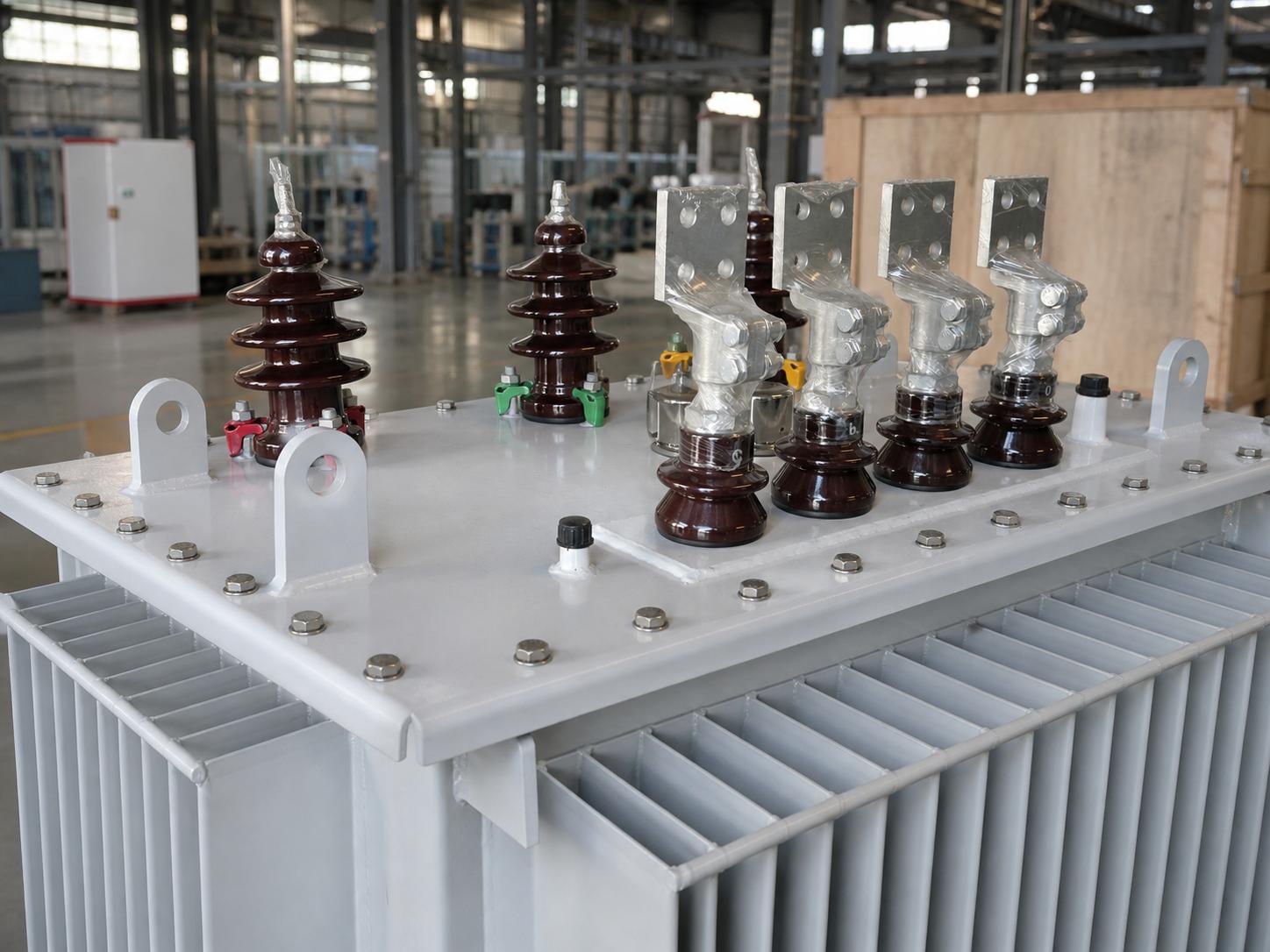
The corrugated tank design used in this unit folds that function into the main tank wall itself. The fins expand and contract with oil volume changes, acting with a kind of natural elasticity that absorbs thermal movement without a separate reservoir.
That single change produces a few practical benefits worth listing out:
- Smaller footprint — no conservator tank means less horizontal or vertical clearance needed, useful in tight substation yards or rooftop installations.
- Fewer leak points — eliminating the connecting pipework between tank and conservator removes a common failure location.
- Better heat dissipation — the corrugated fins increase surface area, which helps pull heat away from the oil during peak load periods.
- Simpler maintenance routines — technicians inspect one integrated structure instead of two separate components.
Monitoring: Knowing Before Something Goes Wrong
A transformer that fails silently is far more expensive than one that gives warning. That's the logic behind the oil level indicator and temperature monitoring built into this design.
The oil level indicator lets a technician confirm insulating oil hasn't dropped below a safe threshold, something that can happen slowly through minor seepage or faster through a real leak. Catching it early is the difference between a scheduled top-up and an emergency shutdown.
Temperature monitoring works alongside that, tracking thermal conditions inside the tank so operators can spot abnormal heating before it accelerates insulation aging. Oil and paper insulation both degrade faster at sustained high temperatures, so this kind of visibility directly extends service life.
Comparing S9 and S11 at a Glance
Buyers evaluating a replacement or a new installation often want the comparison laid out plainly rather than buried in prose. Here's how the two generations stack up on the metrics that matter most for lifetime cost.
| Attribute | S9 Series (Older) | S11 Series (This Unit) |
|---|---|---|
| No-load loss | Baseline | Over 30% lower |
| No-load current | Baseline | 45%–80% lower |
| Oil expansion handling | External conservator tank | Integrated corrugated tank |
| Physical footprint | Larger | More compact |
| Maintenance points | Tank + conservator + piping | Single integrated tank |
The table makes one thing obvious: most of the improvement isn't cosmetic. It's structural, touching both the electrical losses and the mechanical layout at the same time.
Where These Units Actually Get Installed
Specifications only matter in context, so it helps to look at where a 6/10kV oil-immersed unit like this typically ends up doing real work.
- Industrial power distribution grids — factories with heavy, continuous loads benefit most from the no-load loss reduction, since the transformer stays energized around the clock.
- Urban and rural infrastructure projects — municipal utilities value the compact footprint when space near substations or along distribution corridors is limited.
- Commercial building electrical systems — offices and retail complexes need reliable step-down capacity without dedicating excessive rooftop or basement space to equipment.
- Renewable energy integration sites — solar and wind installations often connect through medium-voltage transformers, where efficiency losses compound across many units spread over a site.
Each of these scenarios asks a slightly different question of the transformer, but they converge on the same two priorities: keep losses low, and keep the unit compact enough to fit real-world constraints.
Choosing Between Oil-Immersed and Dry-Type
Not every project calls for an oil-immersed transformer, so it's worth a quick gut check before committing. Oil-immersed units tend to make more sense outdoors or in standalone substations, where fire codes are less restrictive and the superior cooling and dielectric properties of mineral oil can be fully used.
Dry-type transformers, by contrast, suit indoor installations like hospital basements or office towers, where fire safety codes often limit or prohibit oil-filled equipment. If the site sits outdoors, on a concrete pad, with reasonable ventilation, an oil-immersed 6/10kV unit is usually the more cost-effective and thermally efficient choice.
Frequently Asked Questions
Does a lower no-load loss rating affect load capacity?
No. No-load loss relates to core losses present whenever the unit is energized, independent of the load it's serving. This transformer series still delivers its rated capacity across various kVA ratings; it simply wastes less energy doing so.
Is the corrugated tank as durable as a traditional design with a separate conservator?
The corrugated structure is designed to absorb thermal expansion through its own flexibility, which removes a common leak point rather than introducing a new weakness. Fewer joints generally means fewer places for seals to age or fail over time.
How often should the oil level and temperature indicators be checked?
Routine visual inspection during standard maintenance rounds is typical, though exact intervals should follow the manufacturer's guidance and local utility practice, since duty cycle and ambient conditions vary by site.
Can this transformer be used in renewable energy projects?
Yes, medium-voltage distribution transformers rated at 6/10kV are commonly used to step down or aggregate power at solar and wind sites, where efficient no-load performance matters across many parallel units.
Making the Efficiency Case to Decision Makers
Anyone specifying equipment for a long-term installation should treat no-load loss as a recurring line item, not a one-time spec sheet detail. Multiply the savings by the number of hours in a year, and by the expected service life, and the efficiency gap between S9 and S11 designs becomes a budget conversation rather than a technical footnote.
Founded in 2007, FORUI has spent more than eighteen years focused on power transformers, building a product range that spans dry-type, oil-immersed, and special transformer designs for customers across many industries. For teams weighing efficiency, footprint, and long-term reliability in a 6/10kV distribution transformer, the underlying engineering questions stay the same regardless of supplier: how much energy does the unit lose at rest, how well does it manage thermal expansion, and how clearly does it warn operators before something fails. A well-specified power transformer answers all three, and that's what keeps the lights on without surprises.
Recent Posts
- FORUI Makes a Strong Appearance at ENERGETAB Poland 2025, Deepening European Market Presence
- FORUI Presents at Uzbekistan Energy Week 2025, Contributing to Central Asia's Energy Development
- FORUI Shines at Electrical Networks of Russia 2024, Showcasing Strength of Intelligent Manufacturing
- Compact Substation: Engineering Precision in Modular Power Distribution
- Prefabricated Transformer Substation: A Practical Guide to Faster Power Deployment
SUBSCRIBE
INQUIRY