
Prefabricated Transformer Substation: A Practical Guide to Faster Power Deployment
Every power project runs into the same bottleneck eventually: the substation. Traditional builds require weeks of on-site civil work, panel-by-panel wiring, and coordinated inspections before a single kilowatt flows. A prefabricated transformer substation changes that equation by moving the heavy lifting into a factory, where switchgear, transformers, and distribution panels get assembled and tested as one unit long before it reaches the site.
This shift matters more than it might seem at first glance. Contractors and utility planners are under constant pressure to shorten project timelines without cutting corners on safety or reliability. A factory-built substation addresses both concerns at once, which is why it has become a common fixture in industrial parks, renewable energy sites, and transportation infrastructure projects.
What Makes a Substation "Prefabricated"
The term describes a specific manufacturing approach, not just a smaller enclosure. Medium-voltage switchgear, the transformer itself, low-voltage distribution panels, and protection systems are all integrated into a single housing during production. Everything is pre-wired and pre-tested before it ever leaves the factory floor.
That distinction changes how the equipment behaves on site. Instead of coordinating multiple trades to assemble discrete components, crews position one enclosure, connect the incoming and outgoing cables, and run commissioning checks. The engineering complexity that normally accompanies a traditional substation build gets absorbed upstream, during manufacturing, where quality control is easier to enforce.
Auxiliary equipment, such as protection relays and monitoring components, is housed within the same structure. This keeps the electrical system compact without sacrificing the functional separation between medium-voltage and low-voltage sections, which matters for maintenance access later on.
Why On-Site Construction Time Becomes the Real Cost Driver
Ask any project manager where budgets quietly slip, and site labor is usually near the top. Weather delays, subcontractor scheduling conflicts, and sequential inspection requirements can stretch a conventional substation installation over many weeks.
A prefabricated unit compresses that timeline because the bulk of the assembly work has already happened off-site. Since the equipment arrives pre-tested, on-site activity narrows down to placement, cable termination, and final verification. For projects with tight energization deadlines, such as a renewable energy site racing to meet a grid connection date, that difference in schedule risk is often the deciding factor in equipment selection.
It also changes the labor profile required on site. Fewer specialized trades need to be coordinated simultaneously, which reduces the scheduling friction that tends to cascade into delays on larger builds.
Built for Environments That Don't Forgive Weak Enclosures
Substations rarely get placed somewhere convenient. They end up in coastal industrial zones, dusty inland corridors, or remote sites with no permanent shelter nearby. The enclosure has to hold up against all of it without constant intervention.
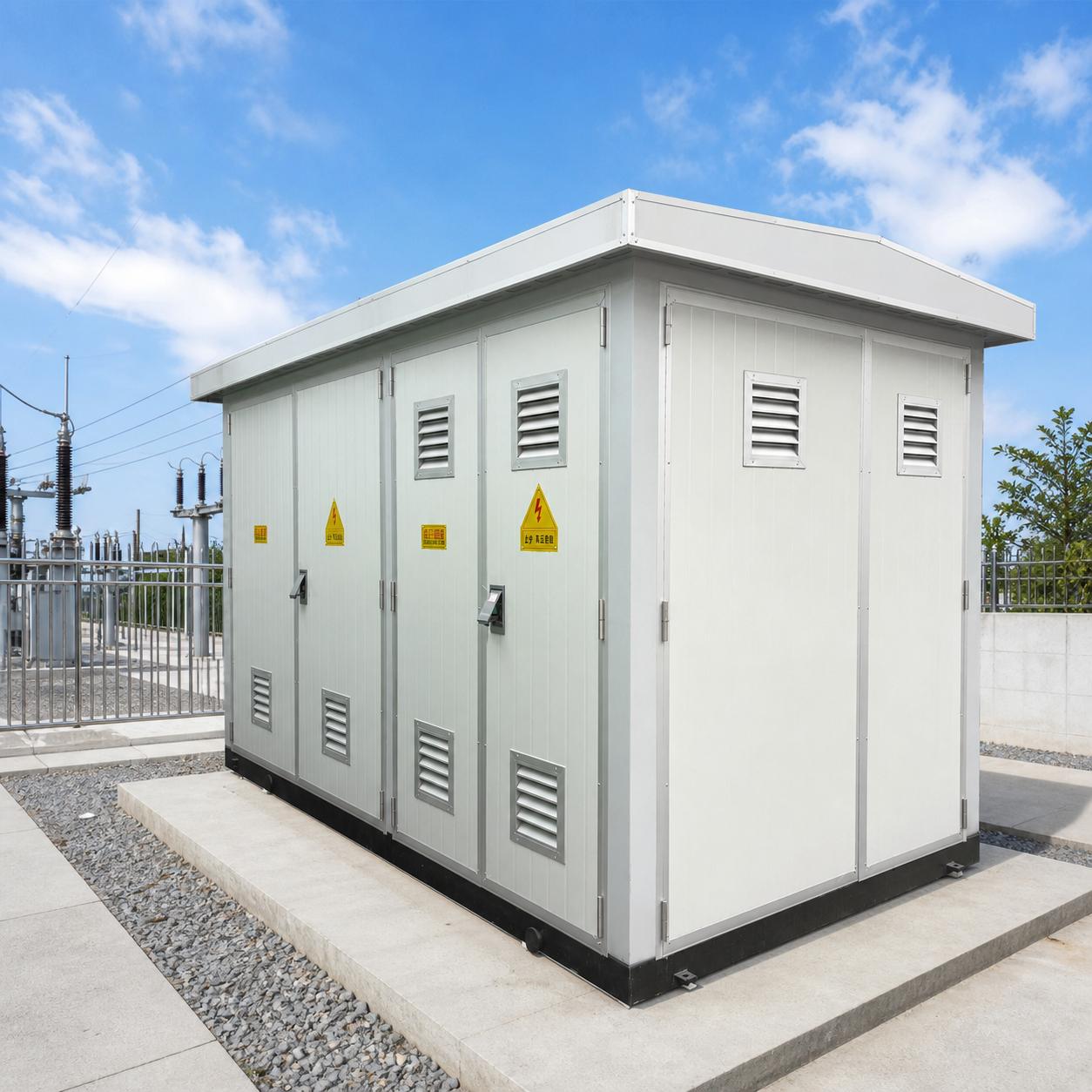
A well-built enclosure relies on a few practical design choices that hold up over years of outdoor exposure:
- Weather resistance: A powder-coated, matte finish over high-strength steel helps the unit resist moisture ingress and UV degradation over years of outdoor exposure.
- Corrosion resistance: Weather-sealed seams and treated surfaces limit the rust and material breakdown common in coastal or high-humidity regions.
- Dust and particulate protection: Sealed access doors with weather-stripping keep fine particulates out of sensitive internal components.
- Mechanical impact resistance: Heavy-gauge construction reduces the risk of damage from incidental contact during operation or maintenance.
None of this is decorative. Each of these properties addresses a specific failure mode that shows up in substations placed in harsh or unattended environments over time.
Ventilation and Drainage Details That Prevent Long-Term Failures
Heat and moisture are the two quiet killers of electrical equipment. A transformer generates heat continuously during operation, and if that heat has nowhere to go, insulation life shortens and failure risk climbs.
The enclosure design typically includes ventilation louvers positioned along the side panels, allowing airflow without exposing internal components directly to wind-driven rain or dust. The roof itself is sloped, paired with integrated ventilation hoods, so rainwater sheds away from the structure instead of pooling on top and working its way into seams over time.
This combination of passive airflow and directed drainage is a deceptively simple detail. It doesn't require moving parts or added energy consumption, yet it directly supports the operational life of the equipment inside, according to the product's design specifications.
Access Points and Cable Entry: The Details Installers Actually Notice
Engineers evaluating a substation on paper tend to focus on electrical ratings. Installers in the field notice something different: how easy the unit is to service once it's live.
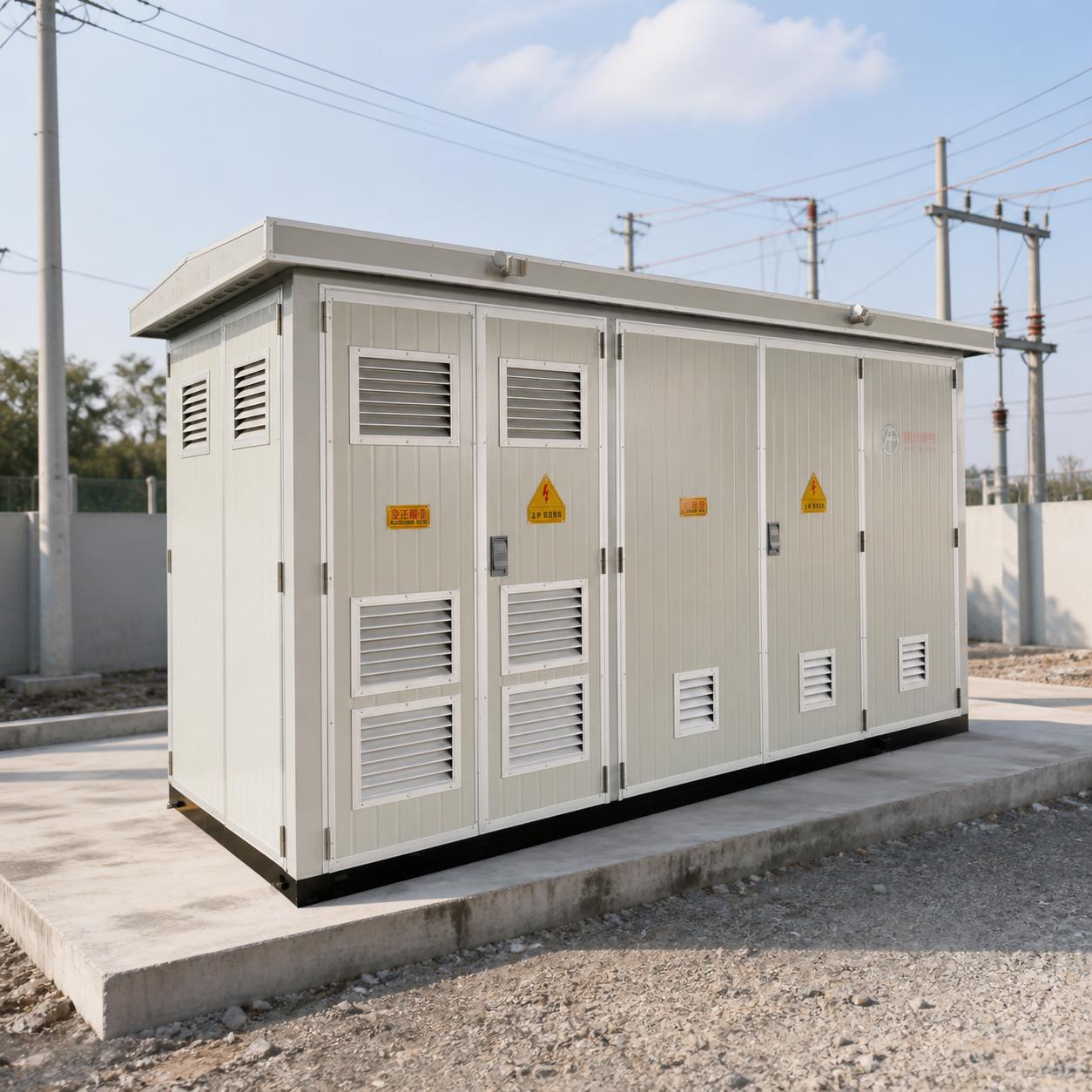
Cable entry ports are positioned on the side panel, keeping incoming and outgoing connections clear of the main access doors. Door hardware uses brushed stainless steel hinges and locking assemblies, which resist the corrosion that cheaper hardware suffers within a few seasons outdoors. Heavy-duty hinges support the access doors across repeated open-close cycles without sagging or misaligning.
These aren't headline features, but they determine how much friction a maintenance crew deals with years into the unit's service life.
Comparing Prefabricated and Traditional Substation Builds
Choosing between a prefabricated unit and a conventional on-site build often comes down to project constraints rather than pure preference. The table below outlines where each approach tends to have the advantage.
| Factor | Prefabricated Substation | Traditional On-Site Build |
|---|---|---|
| Installation timeline | Days to a few weeks after delivery | Several weeks to months |
| On-site labor complexity | Lower; mainly placement and termination | Higher; multiple trades and sequencing |
| Quality control | Factory-tested before shipment | Verified progressively on site |
| Footprint flexibility | Compact, fixed enclosure dimensions | Adjustable to custom civil layouts |
| Suitability for remote sites | High, due to minimal on-site work needed | Lower, due to logistics and labor access |
| Weather exposure during install | Minimal | Significant, since work spans longer periods |
Neither option is universally better. A site with unusual space constraints or highly customized civil requirements may still favor a traditional build. For most standard deployments, though, the compressed timeline and factory-verified quality of a prefabricated unit tend to outweigh that flexibility.
Where These Units Get Deployed
The application range for prefabricated substations is broader than many assume, largely because the core advantage, speed of deployment with predictable quality, applies across very different industries.
- Industrial parks, where multiple tenants need reliable power brought online quickly as facilities are built out in phases.
- Renewable energy projects, particularly solar and wind sites, where grid connection deadlines are often tied to incentive programs or power purchase agreements.
- Transportation infrastructure, including rail and highway projects, where substations are often installed in phases alongside other civil works.
- Public power grids, where utilities need to expand capacity in growing areas without lengthy construction windows.
- City centers and remote areas alike, since the compact footprint suits dense urban lots just as well as it suits locations with limited construction access.
That range is worth noting because it shows the technology isn't a niche solution. It's a general-purpose answer to a problem that shows up across nearly every sector that consumes significant electrical power.
How to Choose the Right Configuration
Selecting a prefabricated substation isn't a one-size-fits-all decision. A few practical questions tend to narrow the field quickly:
- What's the site's environmental exposure? Coastal, high-dust, or high-humidity locations warrant closer scrutiny of the enclosure's corrosion and weatherproofing details.
- How much space is actually available? The compact footprint of a prefabricated unit is an advantage, but confirm clearance for door swing and cable entry access during maintenance.
- What's the project timeline? If energization deadlines are tight, the shorter on-site installation window becomes a primary decision factor rather than a secondary benefit.
- What load profile does the site require? Matching transformer capacity and switchgear configuration to actual demand avoids costly oversizing or, worse, undersizing that limits future expansion.
- Who handles long-term maintenance? Confirm access to service support, since even a robust enclosure benefits from periodic inspection of seals, hinges, and ventilation paths.
Working through these questions before finalizing specifications tends to prevent the most common regret buyers report: choosing a unit that fits the initial budget but not the actual operating conditions.
Frequently Asked Questions
Is a prefabricated substation as reliable as a traditional site-built one?
Reliability depends on manufacturing quality rather than the assembly method itself. Because prefabricated units undergo factory testing before shipment, many issues that would otherwise surface during on-site commissioning get caught earlier in the process.
Can these units handle harsh outdoor climates?
Yes, provided the enclosure specification matches the environment. Weather-resistant, corrosion-resistant, and dust-proof construction are standard considerations for units intended for outdoor or exposed installations.
How long does installation typically take once the unit arrives on site?
It varies by project scope, but on-site work is generally limited to placement, cable termination, and commissioning checks, since the internal assembly and testing were already completed at the factory.
Are these substations suitable for temporary or relocatable installations?
Their compact, self-contained design makes relocation more practical than with a traditional built-in-place substation, though this depends on the specific project's civil and electrical requirements.
Final Thoughts on Choosing a Prefabricated Substation
The appeal of a prefabricated transformer substation isn't just speed, though that's the part most procurement teams notice first. It's the predictability that comes from shifting complex assembly work into a controlled factory environment rather than an open construction site exposed to weather and scheduling variables.
For teams evaluating options, FORUI brings more than 18 years of transformer manufacturing experience to this category, alongside dry-type, oil-immersed, and special transformer solutions built for varied industrial demands. Whether the project involves a renewable energy site under deadline pressure or a public grid expansion in a dense urban area, a well-specified prefabricated transformer substation offers a practical path to getting power online without the extended timelines that traditional builds typically require.
Recent Posts
- FORUI Makes a Strong Appearance at ENERGETAB Poland 2025, Deepening European Market Presence
- FORUI Presents at Uzbekistan Energy Week 2025, Contributing to Central Asia's Energy Development
- FORUI Shines at Electrical Networks of Russia 2024, Showcasing Strength of Intelligent Manufacturing
- Power Transformer Basics: How Oil-Immersed Units Keep the Grid Running
- Compact Substation: Engineering Precision in Modular Power Distribution
SUBSCRIBE
INQUIRY